

Quick Answer
Can I Drink Milk with Amoxicillin? The direct, clinically reassuring answer is yes you can absolutely drink milk with amoxicillin safely. Unlike other common antibiotic classes such as tetracyclines (like doxycycline) or fluoroquinolones (like ciprofloxacin), the active penicillin-based amoxicillin molecule does not bind to divalent calcium ions. This means consuming dairy products, cheese, yogurt, or calcium-enriched plant milks at your dosing window will not trigger a chemical blockade or reduce the absolute volume of medicine your body absorbs.
In fact, swallowing your capsule with a glass of milk or a small snack is an excellent, pharmacist-approved strategy to protect your delicate stomach lining from localized chemical friction. However, you must still maintain highly structured lifestyle boundaries. Avoid consuming dairy if you are using a multi-drug regimen that includes calcium-sensitive compounds, and ensure you do not use burning-hot beverages that can degrade the penicillin ring. Never alter your prescribed dosing frequencies without explicit guidance from your healthcare team.
When Patients Commonly Ask This
Most individuals do not start researching whether can i drink milk with amoxicillin as a general curiosity. Instead, this common search query is usually typed into Google under a wave of sudden panic. Typically, a patient or a worried parent caring for a sick child realizes they have just swallowed their antibiotic dose alongside a cold glass of milk, a bowl of cereal, or a slice of cheese.
Having heard the long-standing medical warning that “dairy products completely neutralize antibiotics,” they immediately panic, believing they have accidentally deactivated their medication and ruined their recovery.
This sudden worry triggers several urgent clinical questions:
- Seriously, can i drink milk with amoxicillin without rendering the drug useless?
- Does the calcium in dairy products create a physical absorption barrier inside my intestines?
- Will giving my child milk after their liquid antibiotic suspension stop it from clearing their ear infection?
- How long do I actually need to wait between eating dairy foods and taking my capsules?
These are exceptionally high-value patient safety questions because understanding the distinct biochemical differences between antibiotic families is essential to eliminating unnecessary panic and maintaining perfect dosing compliance.
Patients looking to optimize their daily recovery timelines or managing unexpected medication side effects should review our foundational safety guides:
Why Amoxicillin Defies the Calcium Binding Trap

To understand the mechanics of why you can drink milk with this specific medication, we must look at a chemical process called chelation. When certain antibiotics enter your digestive tract alongside minerals like calcium, magnesium, iron, or zinc, they undergo a strong chemical reaction. The drug molecule binds directly to the mineral ion, creating an entirely new, heavy chemical compound that is physically too large to pass through your intestinal wall.
As a result, the bound medication is simply flushed out of your system without ever reaching your bloodstream, leading to a dangerous drop in your therapeutic tissue levels.
The molecular structure of amoxicillin, however, completely defies this calcium binding trap. As a beta-lactam penicillin derivative, its chemical ring lacks the specific oxygen-binding groups that attract and lock onto divalent calcium ions.
Because no chelation occurs, your digestive tract absorbs the active drug molecules with 100% efficiency, regardless of whether there is calcium swimming alongside them in your stomach juices. This molecular independence is why clinical guidelines confirm that dairy is completely safe to consume alongside your regular doses.
Antibiotic Dairy Matrix – Identifying Real Calcium Absorption Blocks
| Antibiotic Family & Examples | Can You Drink Milk Directly With Your Dose? | Required Timing Gap If Dairy Is Consumed | The Biochemical Mechanism |
| Penicillins Amoxicillin, Ampicillin | YES. Completely Safe. | No Gap Required. Feel free to take with dairy. | No Chelation. The molecular structure does not bind to calcium ions. |
| Tetracyclines Doxycycline, Minocycline | NO. Dangerous Block. | Wait 2 hours before or 4 hours after your dose. | Strong Chelation. Calcium binds to the drug, reducing absorption by up to 50%. |
| Fluoroquinolones Ciprofloxacin, Levofloxacin | NO. High-Risk Block. | Wait 2 hours before or 6 hours after your dose. | Severe Chelation. Calcium locks onto the molecule, causing treatment failure. |
| Macrolides Azithromycin, Clarithromycin | YES. Generally Safe. | No Gap Required (though food can slightly delay absorption). | No Chelation. Calcium does not chemically lock onto macrolide rings. |
Shielding Your Stomach Wall from Localized Chemical Friction
While establishing that you do not need to avoid dairy is reassuring, using milk strategically can actively improve your physical comfort during therapy. Broad-spectrum penicillin molecules are highly active organic compounds that can cause localized osmotic shifts inside your upper digestive tract.
Taking your capsules on a completely empty stomach can irritate your delicate gastric lining, frequently manifesting as sharp morning nausea, acid reflux, or painful stomach cramps.
Swallowing your dose with a glass of milk or a bowl of yogurt acts as a gentle, soothing buffer that coats your stomach wall. This liquid barrier slows down the rapid dissolution of the drug crystals, allowing the active ingredients to slide smoothly into your duodenum without causing sudden localized chemical friction.
Using Yogurt and Kefir Safely to Rebuild Your Gut Shield
While drinking a plain glass of milk with your medication is completely safe, incorporating fermented dairy products like yogurt, kefir, or cultured buttermilk during your antibiotic therapy offers a massive therapeutic advantage. When a broad-spectrum penicillin derivative enters your digestive tract, it acts as a biological vacuum that wipes out helpful bacteria. This sudden destruction leaves your intestinal lining exposed and highly vulnerable, frequently triggering localized cramping and loose stools.
Fermented dairy products are packed with live, active cultures of beneficial bacteria, such as Lactobacillus acidophilus and Bifidobacterium lactis. Consuming these natural probiotics helps coat your intestinal walls, protecting them from opportunistic pathogens and soothing localized tissue irritation.
However, to get the maximum benefit from these cultured foods, you must still apply a strict timing window. Because amoxicillin is exceptionally efficient at destroying bacterial structures, eating yogurt at the exact same moment you swallow your pill means the drug will instantly neutralize the helpful live bacteria inside your food.
Unbuffered medication delivery and rapid intestinal fluid shifts can cause severe exhaustion during therapy. Keep your system protected by reading our latest clinical reports:
Differentiating Fungal Overgrowth Risks from Simple Dairy Stains
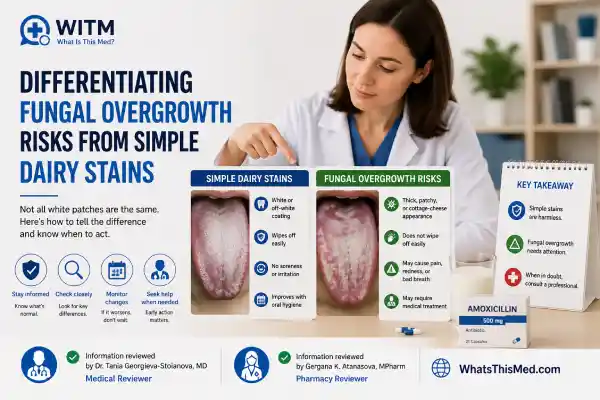
A very common concern that arises when patients drink milk or eat yogurt while taking antibiotics is the sudden appearance of a light-colored coating on their tongue. Many individuals look in the mirror, see a whitish layer, and panic, believing they have instantly developed acute oral thrush (a fungal yeast infection) or a dangerous bacterial overgrowth.
In medical reality, you must learn to separate a simple temporary dairy residue from a true microbial shift:
- Dairy Residue: This is a flat, thin, and harmless film of milk proteins and fats that coats your tongue’s tiny structural bumps (filiform papillae) shortly after eating. It easily washes away when you take a few sips of plain water or use a gentle tongue scraper.
- True Microbial Shifts: If the antibiotic has cleared out your helpful oral bacteria shield, opportunistic yeast or pigment-producing bacteria can take over your oral tissues. This can manifest as thick, creamy white patches that burn when touched, or even a dark, furry appearance.
To learn how to identify, prevent, and clear antibiotic-induced oral tissue shifts safely using targeted hygiene protocols, review our complete clinical guide:
Milk Types and Dairy Alternatives – Compatibility Matrix
| Beverage Type | Calcium Level | Safe to Take Directly with Amoxicillin? | Master Pharmacist Safety Directive |
| Whole Cow’s Milk | High (Approx. 300mg per cup) | YES. Completely Safe. | Excellent choice to buffer your stomach lining against chemical friction. |
| Greek Yogurt / Kefir | High (Packed with live probiotic cultures) | YES. Highly Recommended. | Space these foods at least 2 to 3 hours away from your dose to protect the live bacteria. |
| Almond / Soy Milk | Medium to High (Enriched with calcium carbonate) | YES. Completely Safe. | Safe alternative for lactose-intense patients looking to avoid gut irritation. |
| Goat’s Milk | High (Rich in bioavailable proteins) | YES. Completely Safe. | Thick texture provides a highly soothing coating for an inflamed stomach wall. |
The Danger of Lactose Intolerance Flares During Therapy
If you suffer from mild, underlying lactose sensitivity but can normally tolerate small amounts of dairy during health windows, you should avoid drinking large volumes of milk during your antibiotic course. Because a broad-spectrum penicillin derivative temporarily thins your intestinal lining, your body’s natural production of the lactase enzyme can drop sharply.
Consuming a large glass of cow’s milk when your digestive tract is already vulnerable can trigger severe, painful lower abdominal spasms, explosive watery stools, and intense bloating.
If you want the soothing, protective benefits of a liquid food buffer without risking a lactose flare-up, choose lactose-free milk or calcium-enriched almond or coconut milk to keep your recovery smooth and comfortable.
Managing Pediatric Liquid Suspensions: Milk Mixing Realities

One of the most stressful challenges for parents is attempting to administer a bitter, liquid amoxicillin suspension to a stubborn, sick child. When a toddler flatly refuses to swallow their sweet, cherry-flavored medicine, many parents out of desperation consider mixing the liquid dose directly into a baby bottle filled with warm milk or baby formula.
While we have established that can i drink milk with amoxicillin carries zero chemical risks of calcium absorption blocks, mixing the liquid drug directly into a full bottle of milk is highly discouraged by pediatric pharmacists.
The danger is not chemical, but behavioral: if your child becomes full or refuses to finish the last three ounces of that bottle, they will only receive a partial dose of their antibiotic. This incomplete dosing fails to clear the underlying middle ear or throat infection, allowing the bacteria to mutate and rebound as a stronger, resistant strain.
To administer the dose safely, always give the concentrated liquid medicine directly using an oral syringe, and immediately follow it with a favorite milk beverage as a rewarding chase.
The Prevention & Management Checklist for Patients and Parents
- Feel completely free to drink milk or eat cheese alongside your dose to buffer your stomach lining from chemical friction.
- Never mix liquid antibiotic suspensions directly into a full baby bottle of milk or formula, as incomplete consumption ruins dosing accuracy.
- Space fermented dairy products like yogurt and kefir at least 2 to 3 hours away from your dose to protect the live, beneficial probiotic bacteria.
- Opt for lactose-free or plant-based milks if your stomach is highly sensitive, as antibiotics temporarily lower your lactase enzymes.
- Avoid swallowing your capsules with burning-hot tea or coffee, as excessive heat can degrade the delicate penicillin ring.
- Do not use harsh, alcohol-based mouthwashes to clean away temporary milk residues from your tongue.
- Keep your daily water intake above 2.5 liters to support renal clearance and overall hydration.
- Consult your pharmacist immediately if your antibiotic triggers severe, explosive watery diarrhea (more than 4 episodes daily).
Daily Dosing & Dairy Routine – Optimizing Your System
| Medication Step | Your Safe Dairy Action Item | Why This Protects Your Recovery | Long-Term Health Target |
| Dosing Window | Swallow your capsule with a cool glass of whole milk, lactose-free milk, or alongside a slice of cheese. | Creates a protective physical buffer that coats your gastric lining against early-stage nausea and cramps. | Total elimination of localized upper stomach chemical friction. |
| Hydration Window | Drink plenty of plain, room-temperature water continuously between your dosing schedules. | Assists your kidneys in flushing out the cleared drug components without placing stress on your renal system. | Smooth, consistent drug metabolism with zero systemic headache flares. |
| Microbiome Window | Consume a cup of cultured yogurt or organic kefir exactly 3 hours after your antibiotic dose. | Re-introduces millions of live, helpful bacteria to colonize your lower gut while the circulating drug levels are low. | Successful prevention of antibiotic-induced loose stools and oral overgrowth. |
Frequently Asked Questions – Dairy and Amoxicillin Compatibility
Will drinking a glass of milk with my amoxicillin dose make it take longer to work?
Drinking milk can slightly slow down the overall rate of absorption, meaning the peak drug concentration in your blood may be reached a bit later than if taken on an empty stomach. However, the total volume of medicine absorbed remains identical. This minor delay is clinically insignificant and is highly outweighed by the major benefit of protecting your stomach from nausea.
Can my toddler drink milk immediately after taking their liquid antibiotic suspension?
Yes, your child can drink milk or formula immediately after swallowing their liquid dose. This is a highly recommended pediatric strategy to wash away any lingering bitter tastes from their throat and protect their delicate stomach wall from irritation.
Unexpected fatigue and physical sluggishness in children during therapy require careful monitoring. Check our safety guidelines:
Why Am I Tired After Taking Metformin?
Amoxicillin and Black Hairy Tongue: Shocking Bacterial Overgrowth Truth
Can the calcium in almond milk block my antibiotic the way cow’s milk does?
No, the calcium carbonate used to fortify almond, soy, oat, or coconut milks does not bind to amoxicillin. Since this broad-spectrum penicillin lacks the specific chemical binding groups that attract divalent minerals, you can drink plant-based milks with complete safety.
Should I stop eating yogurt if my tongue develops a white coating?
No, you do not need to stop consuming yogurt, but you should check the surface of your tongue carefully. A thin, flat white layer that easily brushes away is simple dairy residue. However, if the white patches are thick, creamy, and painful, you may be experiencing oral thrush (a fungal yeast infection) triggered by the antibiotic vacuum.
For a complete, step-by-step clinical breakdown on how to identify and clear antibiotic-induced oral shifts safely, review our full report:
Amoxicillin and Black Hairy Tongue: Shocking Bacterial Overgrowth Truth
Can choosing to take my dose with hot hot chocolate break down the medicine?
Yes, using highly hot beverages to wash down your capsules can compromise your recovery. Excessive heat can degrade the delicate chemical bonds of the penicillin ring before it ever reaches your gut. Always use cool or room-temperature liquids to swallow your pills.
Is it safe to eat ice cream while taking amoxicillin?
Yes, eating a small bowl of ice cream is completely safe and can be a highly soothing treat if you are recovering from a painful throat infection or dental surgery. Just be mindful of the high sugar content, which can feed opportunistic yeast cells if your oral microbiome is currently weakened.
Choosing the right pill structure and protective meal buffers is the absolute foundation of long-term intestinal peace. Review our direct formulation guide:
Amoxicillin (500mg & 875mg): Ultimate Master Guide to Safe Dosing, Side Effects, and Microbiome Protection
Can You Take Metformin on an Empty Stomach?
Medical Review Statement
This article was written by a licensed Master Pharmacist, scientifically reviewed by a second licensed Master Pharmacist, and independently reviewed by an actively practicing physician. The clinical profiles, dietary guidelines, and educational materials provided across this platform are intended strictly for general informational purposes. This content cannot substitute for individual, professional medical advice, direct clinical diagnosis, or personalized treatment plans from a licensed healthcare provider. Always consult your doctor or a registered pharmacist before starting, stopping, or changing any medication routine.
Sources
- PubMed Central (PMC). Aminopenicillin Bioavailability, Divalent Cation Chelation Profiles, and Dairy Co-Administration Pharmacokinetics.
- Journal of Clinical Pharmacy. Differentiating Calcium Binding Capacities of Beta-Lactams, Tetracyclines, and Fluoroquinolones.
- American Dental Association (ADA). Pediatric Antibiotic Suspensions, Administration Techniques, and Dosing Compliance Metrics.
- Mayo Clinic Proceedings. Evaluation of Gastric Emptying Times, Salivary Flow Protections, and Intestinal Microbiome Restoration Windows.
Image Disclosure – Dairy and Amoxicillin Compatibility
Some images used on WhatIsThisMed.com may be AI-generated or digitally enhanced for educational and illustrative purposes. These images are intended to support patient understanding and should not be used for self-diagnosis or as a substitute for professional medical evaluation. Whatisthismed.com