

Quick Answer
Amoxicillin and Black Hairy Tongue? Waking up to discover a dark, dark discoloration on your oral tissues after starting an antibiotic course is a deeply terrifying experience, but the connection between amoxicillin and black hairy tongue (clinically known as lingua villosa nigra) is a temporary, benign metabolic condition rather than a permanent disease. The active penicillin molecule acts as a biological vacuum inside your mouth, rapidly wiping out your helpful oral bacteria shield. This rapid depletion allows opportunistic, pigment-producing bacteria and fungi to multiply unchecked.
Despite its shocking, hair-like appearance, amoxicillin and black hairy tongue updates do not involve the growth of real hair tissue. Instead, your tongue’s tiny structural bumps (filiform papillae) fail to shed properly and stretch outward, trapping structural proteins, food particles, and dark microbial pigments. This condition typically resolves completely within a few days through strict oral hygiene protocols and targeted microbiome support. Never stop your prescribed antibiotic course abruptly without consulting your doctor or pharmacist first.
When Patients Commonly Ask This
Most individuals do not spend time reading up on amoxicillin and black hairy tongue parameters when they first receive a prescription for a tooth abscess, sinus infection, or strep throat. Instead, the sudden discovery almost always happens three to seven days into therapy, usually when a patient looks in the mirror after brushing their teeth in the morning.
A typical clinical scenario unfolds like this: A patient is successfully recovering from their primary infection. Suddenly, they notice a yellowish-brown tint on the middle of their tongue that quickly turns into a thick, dark, or black coating that looks visually identical to a patch of fine hair.
This dramatic physical change triggers immediate medical panic, prompting urgent clinical questions:
- What is the true biological connection between amoxicillin and black hairy tongue shifts?
- Is this dark discoloration a sign of tissue death, gangrene, or systemic medication poisoning?
- Why does the surface of my tongue look like it is growing physical fur?
- Should I stop taking my antibiotic doses right away to prevent permanent oral damage?
These are exceptionally vital safety questions because unexpected physical updates inside the oral cavity require immediate structural explanation to provide complete peace of mind.
How Antibiotics Destroy Your Oral Shield

To understand why tracking amoxicillin and black hairy tongue markers matters, we must examine the delicate ecosystem operating inside your mouth. Your oral cavity relies on a protective shield of millions of helpful bacteria that keep local surfaces clean, manage acid balance, and stop harmful pathogens from anchoring to your tissues.
When you introduce a broad-spectrum penicillin derivative like this antibiotic into your system, the medicine cannot separate helpful microbes from dangerous ones. As the active drug circulates through your saliva, it acts as a local vacuum, rapidly knocking out the dominant bacterial strains that maintain your oral balance.
By clearing out these primary bacterial populations, the antibiotic creates a major biological vacuum. Without competition for space or food, opportunistic, color-producing (chromogenic) bacteria and yeast strains take over the surface of your tongue, releasing dark metabolic pigments that stain your structural tissues.
Diagnostic Identification – Black Hairy Tongue vs. Oral Thrush
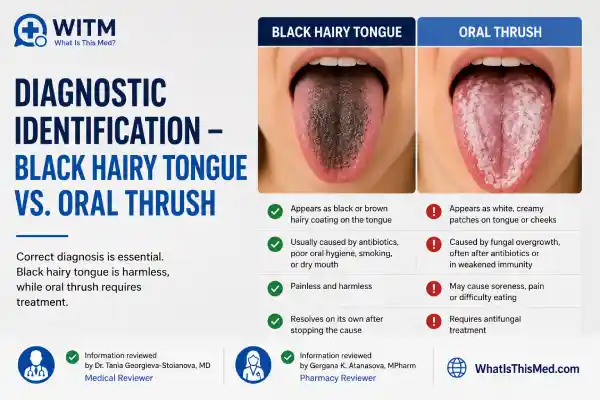
| Evaluation Metric | True Black Hairy Tongue (Lingua Villosa Nigra) | Acute Oral Thrush (Candida Albicans) | Master Pharmacist Safety Priority |
| Primary Visual Appearance | A thick, dark brown, or jet-black carpet covering the top surface of the tongue. | Creamy white, milk-like patches that can spread across cheeks and gums. | Visually mapping the exact color layout rules out secondary fungal invasions. |
| Structural Texture | Highly distinct, elongated, hair-like projections that move when touched. | Flat, curd-like plaques that leave a raw, bleeding surface when scraped away. | True hair-like extensions confirm a structural protein buildup. |
| Localized Pain Levels | Completely Painless; patients report a tickling sensation or altered taste. | Burning pain, heavy tissue soreness, and difficulty swallowing solid foods. | High tissue pain indicates active fungal penetration rather than a simple stain. |
| Primary Driver | Keratin buildup on papillae mixed with bacterial pigments after drug use. | Pure fungal overgrowth triggered by antibiotic-driven immune shifts. | Treatment paths shift completely depending on local tissue pain. |
The Keratin Trap: Why Structural Tissue Projections Stretch Outward
The core physical mechanism behind amoxicillin and black hairy tongue transformations traces back to a breakdown in your tongue’s natural self-cleaning cycle. The surface of your tongue is covered in hundreds of tiny, cone-shaped projections called filiform papillae, which are made of the exact same structural protein found in your fingernails—keratin.
Under normal conditions, these tiny projections wear down continuously as you chew food, drink liquids, and brush your teeth, keeping their length below one millimeter. However, the chemical shifts caused by broad-spectrum penicillins can disrupt this shedding process completely.
Instead of wearing down normally, the papillae keep growing, stretching outward to lengths of up to fifteen millimeters.
Once these projections stretch, they act as a physical trap, capturing sticky food particles, dead cells, coffee stains, and color-producing microbes. The combination of elongated tissue and trapped dark pigments is what creates the shocking appearance of a black, furry tongue surface.
The Keratin Accumulation Timeline: How Fast Does It Spread?
When analyzing the progression of amoxicillin and black hairy tongue, timing is highly dependent on your personal oral hygiene habits and secondary lifestyle triggers. The structural elongation of your filiform papillae does not happen overnight. Instead, it occurs over a rolling window of three to five days as the antibiotic steadily clears out your mouth’s protective bacterial defenses.
At first, you might notice only a slight yellowish or light brown tint near the very back of your throat. If you frequently consume dark liquids like black coffee, tea, or use tobacco products during your antibiotic therapy, these porous, extending keratin fibers will absorb those external pigments like a dry sponge. Within 48 hours of that initial color shift, the staining can spread across the middle surface of your tongue, shifting from a mild brown tint into a thick, jet-black appearance that can cause significant panic if you are unprepared.
Why Dehydration and Low Saliva Production Worsen the Condition

The reason why the visual traits of amoxicillin and black hairy tongue can become so prominent often relates directly to a lack of proper hydration. Saliva is your mouth’s natural self-cleaning fluid; it is packed with protective minerals and enzymes that continuously wash away loose dead cells and keep local bacterial populations fully balanced. When your body is fighting off an underlying infection, your fluid pools are often depleted by low-grade fevers or reduced fluid intake.
This drop in fluid production causes your mouth to become dry and sticky. Without a steady stream of saliva to rinse your oral tissues, the elongated keratin projections become heavily matted together, forming a dense structural carpet that traps pigments even more effectively.
Lifestyle Triggers Worsening Antibiotic-Induced Tongue Staining
| Worsening Daily Trigger | Immediate Impact on Elongated Papillae | Visual Color Shift Direction | Master Pharmacist Prevention Rule |
| Black Coffee / Dark Tea | Porous keratin strands rapidly absorb the dark organic tannins. | Deepens light yellow into an intense, dark brown hue. | Avoid all dark, staining liquids entirely until your oral lining recovers. |
| Severe Fluid Deficits | Low saliva flow stops natural rinsing and mats the tissue strands together. | Creates a thick, dry, and highly reflective dark coating. | Consume a minimum of 2.5 liters of plain water daily during therapy. |
| Tobacco / Smoking | Deposits heavy chemical tars and creates a low-oxygen tissue surface. | Transforms mild staining into a persistent, jet-black carpet. | Eliminate all smoking windows to keep your oral tissues well-oxygenated. |
| Aggressive Mouthwashes | Alcohol-based rinses dry out tissues and worsen the bacterial vacuum. | Accelerates the growth of pigment-producing yeast cells. | Avoid harsh, burning rinses; use plain water or mild saline solutions. |
The Psychological Burden of Oral Tissue Alterations
Discovering a dramatic color shift inside your mouth can cause a high degree of daily anxiety and social discomfort. Many patients find themselves avoiding conversations or hiding their smiles out of fear that the dark coating indicates a severe hygiene failure or a contagious disease. It is crucial to reassure yourself that this condition is purely cosmetic and entirely temporary.
Because the underlying structural changes are limited entirely to the dead keratin layers on the very surface of your tongue, there is no damage occurring to your deep taste buds or blood vessels. Once the antibiotic course ends and your normal lifestyle habits return, your body will naturally re-establish its shedding patterns, clearing the surface within a short stabilization window.
The Risk of Secondary Fungal Invasions
While true amoxicillin and black hairy tongue profiles are driven by a buildup of keratin and pigment-producing bacteria, leaving this dense layer unmanaged can occasionally clear the path for a secondary fungal infection. The crowded spaces between the elongated tissue strands form an ideal, low-oxygen home where common oral yeast cells can begin to anchor.
If your tongue condition begins to shift from a completely painless, dark coating into a raw, burning sensation that makes it difficult to swallow warm liquids, your microbial balance may have shifted further. Keeping the surface clean through a gentle, structured approach is a vital safety step to prevent these opportunistic pathogens from taking over your oral lining during your recovery.
Restoring Your Oral Peace
If your oral symptoms match a true amoxicillin and black hairy tongue profile, you do not need to discontinue your primary antibiotic course. Halting your prescription early can cause your underlying infection to return much stronger. Instead, you can implement a few structured, pharmacist-approved adjustments to safely clean your oral tissues and speed up the shedding of excess keratin.
Implement a Gentle Mechanical Scraping Routine
The most effective way to clear the dark carpet from your tongue is regular, gentle mechanical cleaning. Using a dedicated firm plastic tongue scraper or a soft-bristled toothbrush, brush the surface of your tongue from the back to the front twice daily. Do not scrub aggressively, as this can irritate the delicate tissue base. Applying light, consistent pressure will lift away the trapped food particles, dead cells, and pigment-producing microbes, shortening the tissue strands over several days.
Use a Mild Baking Soda and Saliva Buffer
Avoid using harsh, alcohol-based commercial mouthwashes while your oral lining is recovering, as alcohol dries out the tissue and worsens the bacterial vacuum. Instead, dissolve half a teaspoon of baking soda in a glass of warm water to create a mild oral rinse. Rinsing with this solution after your scraping routine alters the local pH balance, making the surface of your tongue highly inhospitable to pigment-producing bacteria and yeast cells.
Deploy Targeted Oral Microbiome Support
To actively reverse the microbial vacuum caused by your antibiotic therapy, you should introduce high-quality probiotic support. Utilizing dissolvable oral probiotic lozenges containing specialized strains like Streptococcus salivarius (K12 or M18) helps re-colonize your mouth with helpful bacteria. These beneficial microbes anchor to your papillae, blocking dark, pigment-producing pathogens from taking over the tissue again.
The Prevention & Management Checklist for Patients
- Finish your full antibiotic course exactly as directed, unless your doctor advises you to stop.
- Scrape the surface of your tongue twice daily using a dedicated plastic tongue scraper from back to front.
- Drink at least 2.5 to 3 liters of plain water daily to maintain strong saliva flow and prevent dry mouth.
- Avoid all staining liquids like black coffee, dark tea, and red wine until your tongue color completely normalizes.
- Stop all tobacco and smoking habits, as chemical tars rapidly stain extending keratin fibers.
- Rinse with a mild baking soda solution twice daily to keep your oral pH levels balanced.
- Incorporate high-quality oral probiotics to rebuild your mouth’s protective bacterial defenses.
- Contact your doctor immediately if you develop a severe burning pain or difficulty swallowing.
Patient Action Plan – Securing Your Oral Recovery

| Recovery Phase | Your Daily Action Item | How It Corrects Oral Alterations | Long-Term Safety Target |
| Phase 1: Active Clean | Scrape your tongue gently from back to front twice daily after brushing your teeth. | Physically lifts away trapped food debris and shortens elongated keratin fibers. | Rapid reduction in the density of the dark surface coating. |
| Phase 2: pH Buffer | Rinse your mouth with a warm baking soda and water solution after every meal. | Neutralizes organic acids and stops pigment-producing bacteria from multiplying. | Total elimination of persistent dark microbial staining. |
| Phase 3: Rebuild | Dissolve a targeted oral probiotic lozenge in your mouth two hours after your antibiotic dose. | Re-introduces healthy bacterial strains to fill the biological vacuum safely. | Re-establishment of a healthy, pink, and smooth tongue surface. |
Frequently Asked Questions – Amoxicillin and Black Hairy Tongue
Is amoxicillin and black hairy tongue a permanent side effect?
No, experiencing amoxicillin and black hairy tongue is an entirely temporary condition that usually resolves within a few days after finishing your antibiotic course. Once the medicine is cleared from your system, your mouth’s protective bacterial defenses return, allowing your tongue projections to shed naturally and regain their healthy pink appearance.
Will this dark coating affect my sense of taste permanently?
No, the structural changes are limited entirely to the dead keratin layers on the very surface of your tongue. While the thick, trapped debris can temporarily dull your taste buds or cause a metallic taste, it causes zero damage to your deep taste receptors. Your normal taste updates will return fully as the coating clears.
Can using a copper tongue scraper speed up my tissue recovery?
Yes, using either a high-quality copper or plastic tongue scraper is highly recommended by pharmacists. These tools are much more effective than a standard toothbrush for lifting away matted keratin fibers. Always scrape with a gentle, sweeping motion from the back of your throat forward to keep your oral tissues well-protected.
Should I reduce my daily food intake if the coating makes me feel nauseous?
No, you must never implement aggressive calorie restrictions or skip your meals while fighting an infection. The mild nausea or tickling sensation is caused by the physical length of the tissue strands touching your soft palate, not a stomach complication. Focus on eating soft, nutrient-dense foods and drinking plenty of water.
Can choosing to smoke during my antibiotic therapy make the condition permanent?
Smoking will not make the condition permanent, but it will significantly prolong your recovery timeline. Tobacco smoke deposits heavy chemical tars directly into the elongated tissue strands and creates a low-oxygen environment, transforming a mild brown tint into a persistent, jet-black appearance.
Can a transition to liquid amoxicillin prevent this tongue staining?
No, switching to a liquid suspension will not prevent the staining, and it may actually worsen the local discoloration. The liquid medicine makes direct physical contact with the top of your tongue as you swallow, accelerating the local bacterial vacuum and staining the keratin projections directly.
Should I stop taking my antibiotic immediately if my tongue turns black?
No! You must never discontinue your prescribed antibiotic routine on your own out of frustration. Halting your therapy early can cause the underlying bacterial infection to return much stronger. If the structural changes are causing you high anxiety, contact your care team to confirm a gentle cleaning plan.
Medical Review Statement
This article was written by a licensed Master Pharmacist, scientifically reviewed by a second licensed Master Pharmacist, and independently reviewed by an actively practicing physician. The clinical profiles, dietary guidelines, and educational materials provided across this platform are intended strictly for general informational purposes. This content cannot substitute for individual, professional medical advice, direct clinical diagnosis, or personalized treatment plans from a licensed healthcare provider. Always consult your doctor or a registered pharmacist before starting, stopping, or changing any medication routine.
Sources
- PubMed Central (PMC). Oral Microbiome Disruption, Lingua Villosa Nigra Pathogenesis, and Broad-Spectrum Penicillin Complications.
- Journal of Clinical Pharmacy. Differentiating True Black Hairy Tongue from Acute Oral Candidiasis and Fungal Staining Matrix Profiles.
- American Dental Association (ADA). Clinical Safety Tolerability Standards, Keratin Shedding Metrics, and Mechanical Oral Debridement Protocols.
- Mayo Clinic Proceedings. Evaluation of Salivary Flow Dynamics, Localized Gastric Regurgitation Acid Barriers, and Secondary Pathogen Overgrowth.
Image Disclosure – Black Hairy Tongue Truth
Some images used on WhatIsThisMed.com may be AI-generated or digitally enhanced for educational and illustrative purposes. These images are intended to support patient understanding and should not be used for self-diagnosis or as a substitute for professional medical evaluation. Whatisthismed.com