
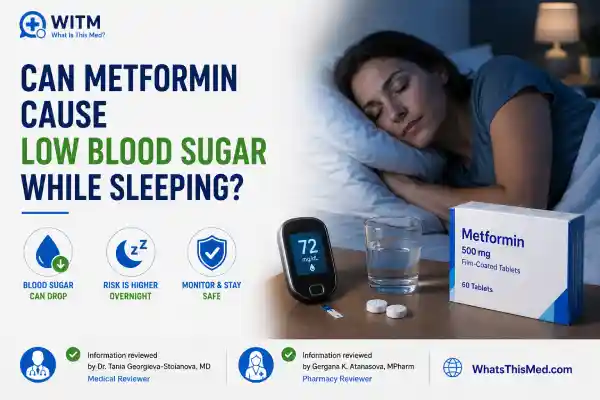
Quick Answer
Can Metformin Cause Low Blood Sugar While Sleeping? The short clinical answer is no when used strictly as a monotherapy, your daily tablet rarely causes severe hypoglycemia because it suppresses hepatic glucose output rather than forcing your pancreas to overproduce insulin. However, the vital question of can metformin cause low blood sugar while sleeping becomes an immediate reality if you combine your prescription with secondary diabetes medications like sulfonylureas or insulin.
When dangerous multi-drug interactions occur or when you pair your treatment with intense carbohydrate restrictions, your glucose numbers can experience a precipitous overnight crash. This specific midnight drop triggers a systemic surge of adrenaline, resulting in classic, dangerous nighttime sweat risks, severe morning tension headaches, and terrifying nightmares.
If you frequently wake up drenched in sweat, you must track your midnight glucose levels using a continuous glucose monitor (CGM). Never alter your prescribed dosing intervals without explicit guidance from your healthcare team.
When Patients Commonly Ask This
Most individuals do not begin typing can metformin cause low blood sugar while sleeping into a search engine during their first few days of type 2 diabetes care. Instead, the terrifying discovery typically happens several weeks into a new metabolic routine when they awaken abruptly in the dead of night.
A typical scenario looks like this: A patient goes to bed feeling completely normal. A few hours into their sleep cycle, they wake up gasping for air, their heart racing violently, and their sheets completely drenched in a cold, clammy film.
Naturally, a wave of deep physical anxiety sets in, forcing the patient to look for immediate clinical answers:
- Really, can metformin cause low blood sugar while sleeping by itself?
- Are my cold chills and heavy shivering signs of dangerous nighttime sweat risks?
- Is my daily medication quietly draining my brain’s primary energy reserves while I rest?
- Should I stop taking my evening dose to prevent a fatal midnight coma?
These are excellent, highly critical safety questions. Severe overnight hypoglycemia is a silent, dangerous complication that must never be brushed aside as a simple bad dream or a minor room temperature issue.
Patients managing complex drug routines and tracking unexpected midnight symptoms should also review these core safety frameworks:
Can Metformin Cause Low Blood Sugar While Sleeping?
Does Metformin Directly Lower Glucose Levels Independently?

To accurately resolve whether can metformin cause low blood sugar while sleeping, we must look closely at the baseline cellular pharmacology of the biguanide molecule. Unlike older, more aggressive type 2 diabetes medications, this drug does not stimulate your pancreatic beta cells to produce additional insulin waves.
Instead, the medication acts as a highly intelligent metabolic modulator that works primarily inside your liver cells to:
- Decrease hepatic gluconeogenesis (the internal production of glucose).
- Increase peripheral insulin sensitivity across your skeletal muscle tissues.
- Slow down the absorption of dietary carbohydrates inside your upper small intestine.
Because the drug simply limits excess glucose production rather than forcing an artificial overproduction of insulin, your body retains its natural counter-regulatory mechanisms. When your blood sugar levels reach a normal baseline, your liver simply stops responding to the drug’s suppressing effects, preventing an unprovoked glucose crash.
Therefore, if you are taking this pill completely on its own, it is pharmacologically incapable of triggering severe hypoglycemia. If you are experiencing dangerous nighttime sweat risks, the root cause is almost always an overlapping lifestyle error or a hidden multi-drug interaction.
Why Indirect Nighttime Sugar Crashes Happen Over Time
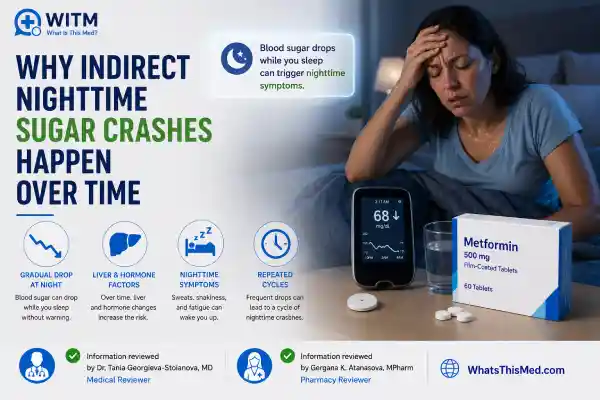
If the medication is safe when used alone, why do so many patients search for can metformin cause low blood sugar while sleeping? The answer lies in overlapping medication regimens and aggressive dietary modifications that overload your body’s energy balance.
The absolute primary cause of experiencing can metformin cause low blood sugar while sleeping is combining your biguanide tablet with secondary, insulin-secreting medications. If your doctor has prescribed a sulfonylurea (such as glimepiride or gliclazide) or a basal insulin injection alongside your regular tablet, the clinical rules alter completely.
While your primary pill sensitizes your tissue cells, the secondary drug forces your body to process sugar relentlessly. When your body enters a fasting state during an eight-hour sleep cycle, this dual-action mechanism can easily drain your circulating bloodstream sugars, leading to an overnight crash.
Furthermore, implementing an unbuffered ketogenic lifestyle or an extended fasting window can severely compound these overnight drops. Forcing your system to process medication without an appropriate glucose buffer can break your liver’s emergency reserves.
Accelerated digestive transit speeds and improper dosing schedules can silently destabilize your overnight metabolic parameters. Read our critical pharmacist safety alerts:
The Dangerous Nighttime Sweat Risks: Identifying Nocturnal Hypoglycemia
When your circulating blood sugar falls below a critical threshold while you rest, your central nervous system perceives the drop as an immediate life-threatening emergency. Your brain requires a non-stop, linear stream of glucose to maintain basic cellular respiration. To combat this sudden energy starvation, your adrenal glands flood your bloodstream with a massive surge of epinephrine (adrenaline) and cortisol.
This sudden adrenaline spike is the direct biological cause behind the dangerous nighttime sweat risks that wake you up in a panic. The hormone forces your peripheral blood vessels to constrict and activates your eccrine sweat glands, resulting in a cold, clammy sweat coating your neck and chest.
Symptom Isolation – Separating Night Sweats from True Overdose Crashes
| Midnight Symptom Profile | Normal Room Temperature Shift | True Dangerous Nighttime Sweat Risks | Immediate Emergency Strategy |
| Skin Moisture & Texture | Warm, dry, or slightly damp skin; resolves quickly by adjusting blankets. | Cold, clammy, and drenched skin; sheets require a complete change. | Check your blood sugar immediately using a bedside glucometer or CGM device. |
| Heart Rate Metrics | Normal resting pulse or minor elevation due to a vivid dream sequence. | Violent palpitations (tachycardia); a bounding chest rhythm that causes visible shaking. | Execute the 15-15 rule immediately by consuming 15 grams of fast-acting simple carbohydrates. |
| Morning Physical State | Feeling refreshed, alert, and ready to manage daily tasks after waking. | Awakening with a severe, throbbing tension headache and profound cognitive confusion. | Document the crash in your tracking diary and read Why Am I Tired After Taking Metformin?. |
If you are routinely ignoring these dangerous nighttime sweat risks because you assume they are a harmless symptom of getting older, you are placing your underlying nervous system at risk. Over multiple months, uncorrected nocturnal hypoglycemia can cause deep vascular strain.
Understanding how your formulation choices impact these sleep-cycle variations by reviewing our report on Metformin Glucophage vs ER Formulation is an essential step to protect your resting metabolism from dangerous overnight drops.
How Medical Doctors Diagnose Overnight Glucose Variability
When a patient seeks clinical assistance regarding can metformin cause low blood sugar while sleeping, a medical practitioner will execute a highly structured evaluation to map your nocturnal glucose trajectory.
Step 1: Continuous Glucose Monitor (CGM) Auditing
Your physician will typically prescribe a wearable CGM sensor for a two-week tracking window. This advanced device records your interstitial tissue sugar numbers every five minutes throughout your sleep cycle, revealing exactly if, when, and how low your levels drop.
Step 2: Evaluation of Macro-Nutrient Buffers
Your care team will review your dinner timeline and physical activity schedules. If you are executing intense exercise late in the evening without adjusting your food intake, your muscle tissues will continuously pull sugar out of your blood while you rest, triggering delayed crashes.
Step 3: Comprehensive Serum Evaluation
Your doctor will check your baseline organ function to ensure your body is clearing your daily medications at a normal physiological rate.
Diagnostic Laboratory Matrix – Testing for Hypoglycemic Factors
| Measured Serum Metric | What This Biological Marker Evaluates | Normal Target Range | Delayed Multi-Drug Overnight Crash Finding |
| eGFR (Glomerular Filtration) | Your kidney’s physical capacity to filter out and clear active medication crystals. | Above 60 mL/min/1.73m² | Significantly Decreased. Accumulation of medicine extends active drug windows. |
| Fasting Serum Insulin | The baseline volume of active insulin molecules moving through your bloodstream. | 2.6 to 24.9 uIU/mL | Highly Elevated. Confirms an external drug is forcing an overproduction of insulin. |
| HbA1c (Glycated Hemoglobin) | Your comprehensive 3-month average of blood glucose management. | Below 5.7% (Non-diabetic) | Critically Low. Points to overly aggressive medication dosing intervals. |
If your laboratory panels confirm that your kidneys are clearing your prescription normally, it proves that your can metformin cause low blood sugar while sleeping issue is driven by lifestyle timing or secondary drug interactions. Correcting these parameters will allow you to maintain exceptional glucose control without experiencing dangerous nighttime sweat risks.
Improper medication accumulation can drain your body’s base nutrient stores over multiple months of therapy. Protect your system by reading our clinical guides:
Step-by-Step Action Plan to Manage and Prevent Overnight Drops
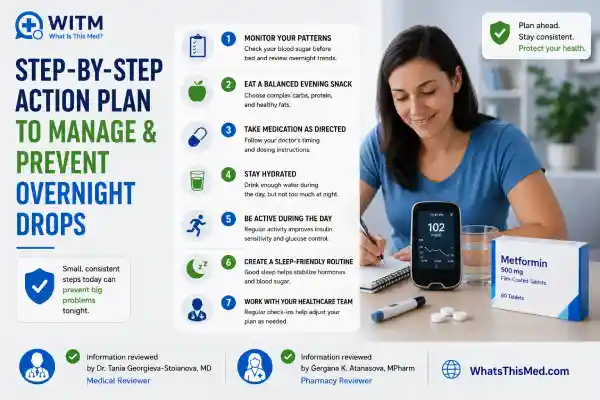
If you are dealing with a persistent fear of can metformin cause low blood sugar while sleeping, you can use this pharmacist-approved action plan to secure your nighttime routine:
Step 1: Establish a Fixed Bedtime Snack Routine
If your CGM shows your sugar levels dip into a lower zone around 3:00 AM, you should introduce a small, complex macronutrient buffer right before you go to sleep. Consuming a handful of raw almonds or a piece of whole-grain toast with peanut butter provides a slow-releasing energy cushion that prevents overnight drops.
Step 2: Transition to a Long-Acting Extended-Release Formula
Standard regular tablets can cause sharp, erratic absorption spikes inside your upper intestines. Discussing a transition to an extended-release (ER) formula with your doctor allows the medicine to dissolve evenly over twelve hours, preventing sudden midnight fluid and metabolic shifts.
Step 3: Re-evaluate Your Late-Day Beverage Habits
Drinking highly caffeinated or acidic beverages late in the afternoon can disrupt your sleep architecture and mask early symptoms of nocturnal hypoglycemia. To ensure your body can awaken naturally during a real emergency, learn the rules of beverage safety by checking our report on Can I Drink Coffee While Taking Metformin?.
Prevention Checklist – Securing Your Sleep Cycle Against Hypoglycemia
| Prevention Step | Daily Patient Action Item | How It Corrects Dangerous Nighttime Sweat Risks | Long-Term Safety Target |
| Step 1 | Check your glucose levels right before turning off your bedroom lights. | Identifies a low baseline before you enter an eight-hour fasting window. | Elimination of unprovoked midnight adrenaline surges. |
| Step 2 | Never administer a late-evening dose on a completely empty stomach. | Provides a dense physical food mass that buffers the drug’s natural metabolic shift. | Stable, linear overnight tissue absorption patterns. |
| Step 3 | Keep a fast-acting liquid sugar source resting directly on your nightstand. | Guarantees instant access to glucose if can metformin cause low blood sugar while sleeping issues wake you up. | Immediate protection against severe cognitive confusion and fainting. |
FAQ Block – Can Metformin Cause Low Blood Sugar While Sleeping?
Can metformin cause low blood sugar while sleeping if taken by itself?
No, when utilized as a standalone monotherapy, the answer to can metformin cause low blood sugar while sleeping is almost always no. The drug does not stimulate your pancreas to produce extra insulin; instead, it simply limits excess glucose production by your liver, making standalone overnight crashes exceptionally rare.
Why do I experience dangerous nighttime sweat risks every time I take my evening dose?
Experiencing dangerous nighttime sweat risks typically indicates that your blood sugar is dropping overnight due to combining your medication with insulin-secreting drugs, engaging in strenuous late-evening exercise, or maintaining an extreme carbohydrate restriction without an adequate food buffer.
How does choosing to take metformin on an empty stomach impact my sleep quality?
Taking your pill without food can severely disrupt your sleep because it exposes your unprotected stomach lining to raw drug crystals. This lack of a food buffer accelerates local osmotic fluid shifts, leading to intense cramping, lower bowel irritation, and indirect sleep fragmentation.
Should I skip my evening dose if my bedtime blood sugar reading looks too low?
No, you must never skip a prescribed dose or alter your medication timing on your own without explicit professional guidance. Skipping doses can cause unprovoked spikes in your morning fasting glucose numbers. If your reading is low, consume a small complex carbohydrate snack instead.
What should I do immediately if I wake up with cold sweats and violent heart palpitations?
If you experience sudden, dangerous nighttime sweat risks, check your blood sugar immediately. If your monitor reads below 70 mg/dL, apply the 15-15 rule: consume 15 grams of fast-acting simple carbohydrates (such as 4 ounces of fruit juice) and re-check your levels in exactly 15 minutes.
Medical Disclaimer
The comprehensive clinical profiles, dietary guidelines, and educational materials provided across this article are intended strictly for general informational purposes. This content cannot substitute for individual, professional medical advice, direct clinical diagnosis, or personalized treatment plans from a licensed healthcare provider. Never change your prescription schedule, alter your medication timing, or stop your diabetes management plan without explicitly consulting your primary care physician or a registered pharmacist.
Sources
- PubMed Central (PMC). Continuous Glucose Monitoring Metrics, Nocturnal Hypoglycemia Pathways, and Counter-Regulatory Hormonal Spikes in Biguanide Therapies.
- Journal of Clinical Pharmacy. Differentiating Standalone Monotherapy Profiles from Multi-Drug Sulfonylurea Interactions and Overnight Crashes.
- American Diabetes Association (ADA). Clinical Safety Tolerability Standards, Bedtime Macronutrient Buffers, and Extended-Release Switching Frameworks.
- Mayo Clinic Proceedings. Evaluation of Nocturnal Diaphoresis, Epinephrine Surges, and Secondary Water-Soluble Nutrient Depletions in Chronic Diabetes Care.
Image Disclosure – Nocturnal Hypoglycemia
Some images used on WhatIsThisMed.com may be AI-generated or digitally enhanced for educational and illustrative purposes. These images are intended to support patient understanding and should not be used for self-diagnosis or as a substitute for professional medical evaluation. Whatisthismed.com